
The time of the Olive Trees
Among the ancient olives of Le Dolci Colline, in the heart of Umbria, time doesn't stop — it slows down just enough to remind you how to breathe.
The exhaustion you leave behind
There comes a moment, somewhere in the middle of the week, when you realise you can no longer finish a thought. You open an email, a notification fires, your phone rings. You go back to the email. The thought has gone. You can't even remember what it was about.
You start from here. From this very particular, very measurable kind of tiredness — the kind that comes from a mind spinning endlessly, an engine running hard and going nowhere.
The road that won't be rushed
The lane that climbs towards Le Dolci Colline is not an important road. It is narrow, edged with old dry-stone walls. Someone, years ago, planted geraniums in a rusted tin drum.
They are still there. The car slows of its own accord, because there is nothing else to do, because the road simply does not allow for hurry.
You arrive and there is nothing spectacular about it. No illuminated signs, no background music playing from hidden speakers. There is Stefano, waiting by the gate with his hands in his pockets, who says good morning the way someone does when they have all the time in the world.
He probably has.

The first olive tree
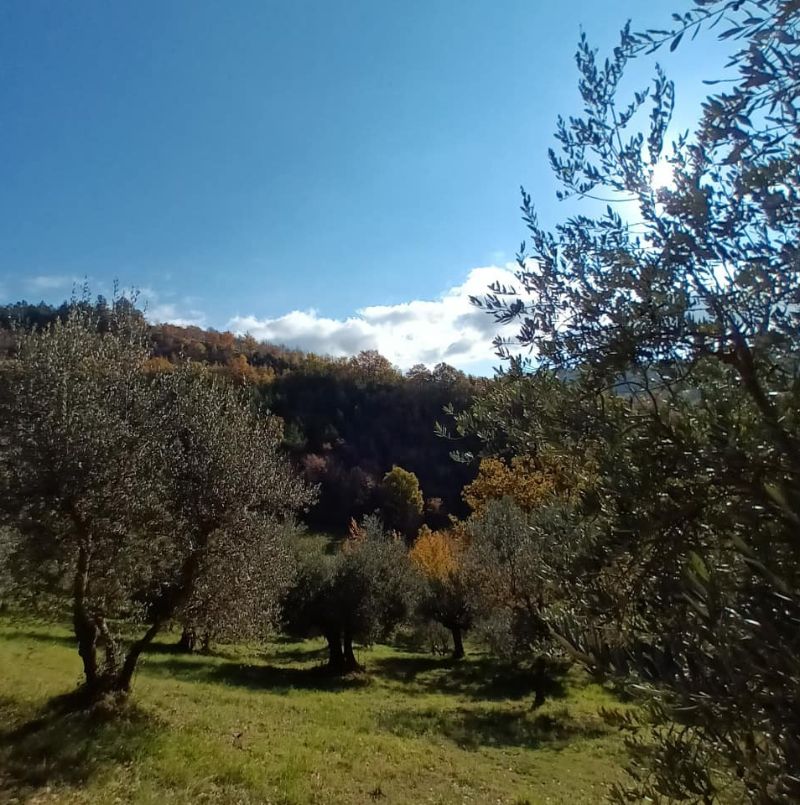
The olive trees begin almost immediately, just beyond the courtyard.
The first one you meet has a trunk you cannot get your arms around. The bark is silver-grey, carved with spirals that wind upward as though the tree had been slowly wrung through the centuries.
You want to touch it, so you do: it is rough beneath your fingers, cool in the shade, warmer where it catches the sun. Your hands find crevices, swellings, small hollows where something once lived and left no name.
Stefano mentions the tree is over two hundred years old. Then he stops talking.
A silence that is full
The silence here is not an absence of sound. It is a full silence.
It is the same rhythm you find when, among these very trees, you draw a bow and let an arrow fly.
There is the rustle of the leaves — small, lance-shaped, dark green on top and silvery beneath — stirring even when you feel no wind. There is the song of a bird you cannot find among the branches. There is the dull thud of your footsteps on dry grass, and the softer sound where the ground is still damp in the shadow of a trunk.
There is your own breathing, which after a while begins to slow, quite without your deciding anything about it.
You walk among the trees and notice things you would ordinarily miss. The light falls through the branches unevenly: pools of brightness shifting slowly across the ground, as though someone were moving a gauze screen above you.
In one of these pools, a lizard sits perfectly still, soaking up the warmth with no intention of moving. You watch it. It watches you. Then it doesn't.
You stop
At some point you do a strange thing: you stop.
Not because there is something particular to look at. Not to take a photograph. You simply stop, your back resting against an old trunk, and stay there for a few minutes. The ground underfoot is hard, packed, faintly sloping. You become aware of your weight settling differently than it does in an office chair.
Your shoulders drop. You hadn't noticed you were holding them up.
Stefano is a few trees away. He isn't waiting for you, isn't calling you over. He is absorbed in something among the leaves of one of the plants. Perhaps looking for something. Perhaps not.
That same unhurried focus is what he carries to his beehives when the blossom comes — another way he has of paying attention to this land.
The thoughts step aside
The difficult thing to explain is this: at a certain point you stop thinking about home, about work, about the email you never finished reading. Not because anything has been resolved. Simply because the place is larger than your thoughts, and they quietly step aside.
It is not meditation. It is not therapy. It is just that you are walking among trees that were already old when the Battle of Waterloo was fought, and somehow, for reasons you couldn't quite articulate, that puts things in their proper proportion.
The bruschetta
At the end, there is bruschetta.
Not any bruschetta. The bread is toasted over real embers, still warm, the crust crackling when you bite into it. The oil is green and dense, with a bitter, peppery finish that catches at the back of your throat — the sort that labels call "intense and fruity" but which really just tastes of freshly picked olives, of cold morning air, of everything you have just walked through.
You eat standing up, beneath a tree, fingers glistening, in no hurry at all to wipe them clean.
If this place calls you back — another season, an earlier morning — there is what this same earth keeps hidden just below the surface, and Stefano and Luna know exactly where to look.
"You leave after about an hour and a half. The lane back down to the valley is the same as before — narrow, unhurried, the geraniums still in their rusted drum. But you are not quite the same. Not transformed, not enlightened. Just a little quieter inside. As though something, for a moment, had stopped making noise."
Ready?
Experience something that will stay with you as more than just a memory.
The time of the olive trees at Agriturismo Le Dolci Colline
Add this experience to your stay and savour nature at its most authentic.
↑ Scroll the page to visualize sticky CTA ↑